
'The protective effect of the vaccine lasts for about nine months to a year.' 'For health workers that period is already over. This is the right time to augment their immunity.'

Less than 30,000 booster doses daily in December.

'If there are any symptoms/variants of concern, states can prepare accordingly.'
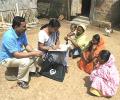
Although the Disaster Management Act for Covid containment measures, considered a hindrance in conducting the census, was withdrawn in March this year the Centre has not taken any further action on conducting the much-delayed population enumeration.

To ramp up domestic battery manufacturing capacity and reduce the dependence on imports, the government has initiated talks with a few lithium-rich countries to supply the mineral to Indian companies, industry sources informed Business Standard. The Ministry of External Affairs (MEA) held a meeting with the ambassadors of countries, including Argentina, Chile, and Bolivia, among others, to put forth its request.

Shipments of sunflower oil to India have started normalising after imports from war-torn Ukraine resumed beginning September after a gap of four months, leading to further normalisation of supplies. Ukraine has been the largest supplier of sunflower oil to India. However, after the Russia-Ukraine war broke out in February, supplies from Ukraine dwindled as Russia denied it access to the Black Sea ports.
We are looking at bringing quality control orders for mass production items such as smart meters and ceiling fans. This will benefit our own industry and consumers, a government official said.

India is unlikely to join the ongoing negotiations for a plurilateral deal on e-commerce at the World Trade Organization (WTO), notwithstanding a change in stance on data localisation and cross-border flow of data. Under the new draft digital personal data protection (DPDP) Bill, put out on Friday for public consultation, the government has proposed free cross-border flow of data with 'friendly' nations, significantly easing its earlier stance on data localisation. India has so far stayed out of a group of 87 countries, including the US, European Union, China, and Japan that are negotiating trade-related aspects on e-commerce since December 2017.

The National Financial Reporting Authority (NFRA) has issued guidelines to inspect select audit firms to identify areas and opportunities for improvement in the audit firm's system of quality control, a statement said. "Inspections will consist firm-wide review of audit quality and individual file reviews on test-check basis to evaluate the level of compliance with applicable auditing standards and quality control policy and processes," NFRA said. The selection of the audit firm or the auditor for such inspection by NFRA would be based on assessment of risks in the audit environment.

Reliance Industries chairman Mukesh Ambani might have made news for purchasing the most expensive beach-side villa in Dubai recently, but he is not the only Indian eyeing the city for investment. Since Dubai allowed foreign investors full ownership in specific sectors in June 2021, a horde of Indian companies have moved or expanded into the desert city. The list even includes a kindergarten, an elementary and middle school, and a hotel that has sought 100 per cent ownership.

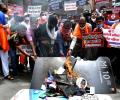
In a multi-city protest on Monday, a large number of company secretaries (CS) and chartered accountants (CAs) came together to seek extension of the deadline for annual filing due to glitches in the ministry of corporate affairs (MCA) portal. According to the Companies Act, firms are supposed to submit Form AOC 4 for filing of the balance sheet within 30 days of holding the annual general meeting (AGM). This deadline was over on October 29.

The credit guarantee cover under the scheme would be both transaction-based (for single eligible borrowers) and umbrella-based (for a group of eligible borrowers).

About 56 million Indians may have plunged into extreme poverty in 2020 as a result of the pandemic, increasing the global tally by 71 million and making it the worst year for poverty reduction since World War II, according to fresh estimates by the World Bank. "The global goal of ending extreme poverty by 2030 is likely to be missed: By then, about 600 million people will remain in abject poverty. A major course correction is needed," Indermit Gill, chief economist at the World Bank, tweeted. The World Bank in its latest "Poverty and Shared Prosperity" made fresh estimates of poverty using a new extreme poverty line based on the purchasing power parity (PPP) of $2.15, the earlier one being at $1.9.

To set up a future-ready administration geared towards the target of $2 trillion exports by 2030, the Department of Commerce has decided to set up a dedicated trade promotion body to drive overall promotion strategy, export targets, and execution as part of a restructuring exercise. The trade promotion body will formulate and drive overall trade promotion strategy; create and drive India's branding across focus markets and sectors; drive coordinated action across missions, states and export promotion councils; strategic initiatives, including advisory and buyer-seller meet; and develop digital platforms for exporters and buyers. Based on a 14-volume 'restructuring dossier' by the Boston Consulting Group, the commerce department has already implemented some of the recommendations.

Once the iconic red-brick building of British India Corporation (BICL), which manufactured the popular "Lal-Imli" brand of woollen products, made Cawnpore (now Kanpur) the Manchester of the East. In the 75th year of independence, the government may finally pull the curtains on the century-old, now defunct public sector enterprise. "The Department of Public Enterprises (DPE) has floated a draft cabinet note for closure of British India Corporation (BICL) along with National Textiles Corporation (NTC). "The Cabinet may soon tak

Even as the bilateral relationship between the two neighbouring countries remains hostile, there is growing coordination between India and Pakistan on one multilateral forum - the World Trade Organization (WTO). Both countries have made two joint submissions at the WTO as co-sponsors in the past two months. In June, Pakistan joined India, Cuba, and 44 African countries, seeking sufficient flexibility in intellectual property rights for developing countries to fight the Covid-19 pandemic.
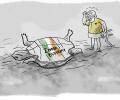
The International Monetary Fund (IMF) on Tuesday slashed India's growth forecast for 2022-23 (FY23) by 80 basis points to 7.4 per cent, citing less favourable external conditions and rapid policy tightening by the central bank. In its update to the April World Economic Outlook, the IMF said that though a global recession in 2022 was ruled out with a growth estimate of 3.2 per cent, the balance of risks was squarely to the downside, driven by a wide range of factors that could adversely affect the global economic performance. "The risk of recession is particularly prominent in 2023, when in several economies growth is expected to bottom out, household savings accumulated during the pandemic will have declined, and even small shocks could cause economies to stall.

A depreciating rupee, which briefly hit 80 to the dollar on Tuesday, may boost India's exports but price-inelastic imports of crude oil and gold would mean limited relief on the trade deficit, which clocked a record $26.2 billion in June. Due to global risk aversion on the back of geo-political tensions and aggressive policy tightening by the Fed, the dollar has appreciated against most currencies, including the rupee. And, with other currencies depreciating, India's comparative advantage in this respect may be limited.

'We actually have a problem because there may be too much activity in India.' 'Markets don't like too much concentration. But we are very happy with our collaborations in India.'
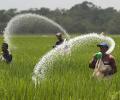
As the kharif season is setting in, India is scrambling to source fertilisers from the international market. It is set to sign long-term contracts - especially with Morocco and Latin American countries - to ensure steady flow of supplies. "We have to source fertilisers wherever it is available because crops have to be secured.
 © 2026 Rediff.com - Advertise with us - Disclaimer - Privacy Policy - Sitemap - Feedback - About us - Terms of use - Grievances